Showing posts with label USA. Show all posts

Thursday, December 22, 2011

AFRICOM: Um olhar mais abrangente sobre África

Africom is the most recent U.S. combatant command that includes Africa in its area of responsability. This article, written in portuguese, summarizes the its mission and action, as well as the reactions to its criation.
Pedro Barge Cunha, Jornal Defesa e Relações Internacionais


Wednesday, December 7, 2011

Africa: US Foreign Assistance Issues

The United States provides assistance to 47 African countries, and the United States Agency for International Development (USAID) has 23 missions in Africa. In recent years, U.S. assistance to Africa saw a major increase, especially in health-related programs. Aid to Africa quadrupled from $1.1 billion in FY2006 to nearly $8.2 billion in FY2009. In FY2010, Africa is expected to receive an estimated $7.05 billion. The Obama Administration has requested an estimated $7.6 billion for FY2011. In FY2009, the United States provided more than $1 billion in humanitarian assistance to Africa. Africa is also a major recipient of the Millennium Challenge Account (MCA) funding, with 15 African countries currently participating in the program.
Ted Dagne, Congressional Research Service

Sunday, December 4, 2011

Refining American Strategy in Africa

This is an old study from 2000, but it is very useful if you want to compare the previous and after 9/11 era. In this study, Dr. Steven Metz provides a broad overview of the African security environment as a basis for recommendations on the refinement of American strategy in that region. He assesses both the opportunities for positive change which exist today, and the obstacles. While only Africans themselves can determine the future of their region, an American strategy which discourages proxy aggression, encourages private initiatives in the economic and political spheres, and uses the U.S. military, particularly the Army, to engage its African counterparts could pay great dividends.
Steven Metz, SSI


Friday, November 18, 2011

AFRICOM: The Road Ahead for United States Africa Command

The formation of AFRICOM is linked to a number of new and evolving geostrategic and security considerations that the U.S. is facing in Africa, most notably humanitarian and development interests, energy security, terrorism, failed and failing states, and may be, if we’re allowed to say it, rising Chinese intentions and interests on that continent.
Robert Moeller, Brookings Institution


Horn of Africa: Current Conditions and U.S. Policy

This document contains the speeches of the Hearing before the subcommittee on Africa and Global Health of the committee on Foreign Affairs in the House of Representatives.

Should Zimbabwe Join the Southern African Customs Union?

This paper addresses an important issue that has the potential to impact significantly on the economic and political stability of Zimbabwe and southern Africa: should Zimbabwe join the Southern African Customs Union (SACU)? The Zimbabwe–SACU relationship is complex, dynamic and multi-layered, making a simple yes or no answer to this question inappropriate. However, aligning Zimbabwe with the most effectively functioning customs union in Africa offers great opportunities to promote cooperation, coordination and integration between South Africa, undoubtedly Africa’s most powerful economy, and Zimbabwe. This paper, after examining the SACU–Zimbabwe relationship in terms of good governance, revenue-sharing, trade and common policies, concludes that now is not the time for Zimbabwe to join SACU. However, in the longer-term, promoting Zimbabwe’s integration with SACU, its major trading partner, has the potential to increase trade, investment and development in Zimbabwe. It could also lock-in domestic policy reform and, if accepted into SACU, add considerable legitimacy to the Zimbabwe policy environment.
Richard Gibb, The Brenthurst Foundation

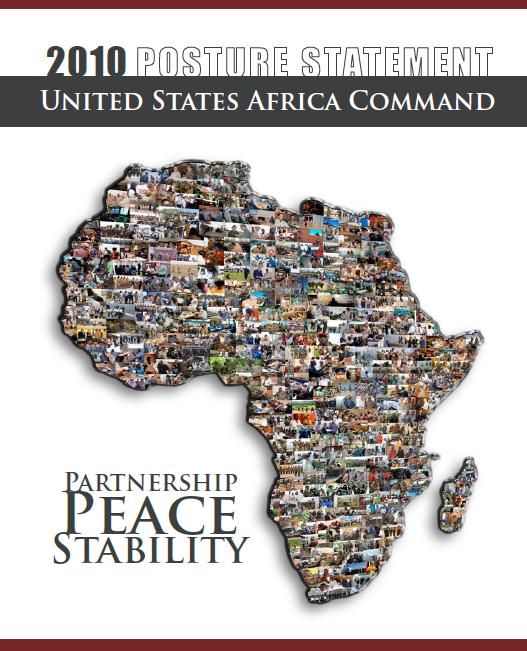
2010 Posture Statement: United States Africa Command

Every year, the commanders of the US Africa Command publish their posture towards Africa. This book contains the William Ward's perspectives, related to AFRICOM's mission and action.

William Ward, AFRICOM

Sunday, October 23, 2011

AFRICOM: The American Military and Public Diplomacy in Africa

Officials of the Defense and State departments cite a commitment to public diplomacy as an essential element of AFRICOM, the U.S. military command for Africa created in 2007. Questions remain, however, about whether a military command can and should engage in public diplomacy.
Philip Seib, Figueroa Press

Friday, October 14, 2011

African Conflicts and U.S. Diplomacy

The Center for Strategic and International Studies (CSIS) and the American Academy of Diplomacy (AAD) cohosted a conference on October 29, 2009, to examine the role of diplomacy in U.S. relations with Africa. Discussions were grounded in the belief that as U.S. interests and engagement in Africa expand, U.S. diplomatic capacities must expand accordingly. The need to effectively manage multiple strands of U.S. investments in security, development, and conflict mitigation and management has become more complex and more important. The United States faces a far more competitive environment in Africa than in previous decades, with “emerging powers”—most notably China, India, Brazil, and a number of smaller Asian states—making major political and economic plays, and with regional organizations, transnational influences, and African civil societies asserting themselves more and more in national affairs. At the same time, the United States faces continuing constraints in diplomatic resources and personnel. In this context, the United States will need to identify how best to use its influence in Africa, which policy areas and places it should prioritize, and how to balance effectively the use of diplomatic, military, and developmental tools.
Jennifer G. Cooke and Richard Downie, CSIS

Wednesday, October 12, 2011

Radical Islam in East Africa

Historically, Africa has not been a central theater in U.S. strategic planning. U.S. interests there have been viewed as marginal, and the threats to those interests have not been considered serious enough to require the deployment of significant resources or policy attention. In recent years, however, Africa has come to be regarded as an increasingly important region, where American geopolitical interests and the potential threats to those interests are both on the rise. Consequently, the Department of Defense is abandoning its traditional policy of strategic minimalism in favor of a more robust approach, signified most prominently by the establishment of a unified combatant command for Africa.
Angel Rabasa, RAND

Thursday, September 29, 2011

U.S. Counterterrorism in Sub-Saharan Africa: understanding costs, cultures and conflicts

In this Letort Paper, Dr. Donovan C. Chau examines U.S. counterterrorism policy in SSA. He begins by analyzing the policy debate in Washington, DC, especially the fundamental divergence of approaches between development and defense. From there, the paper shifts to a discussion of the attitudes and views of terrorism and counterterrorism in SSA. Vast and diverse, SSA is divided subregionally into East, West, and Southern Africa so as to highlight the different geographies, histories, threats, and perceptions.
Donovan C. Chau, Strategic Studies Institute

Wednesday, September 28, 2011

Feed the Future Guide

Feed the Future (FTF), the U.S. government’s global hunger and food security initiative, renews our commitment to invest in sustainably reducing hunger and poverty. At L’Aquila, President Obama’s pledge of at least $3.5 billion for agricultural development and food security over three years helped to leverage and align more than $18.5 billion from other donors in support of a common approach. The 2009 G8 and G20 Summits established a framework for coordinated and comprehensive action among host governments, donors, civil society, the private sector, and other stakeholders. The five principles of a common approach, first articulated at L’Aquila, embrace the Paris Declaration on Aid Effectiveness and the Accra Agenda for Action, and were endorsed unanimously as the Rome Principles for Sustainable Food Security by 193 countries at the 2009 World Summit on Food Security.
US Government Iniciative

Sunday, September 25, 2011

Examining US Counterterrorism Priorities and Strategy Across Africa's Sahel Region

Al-Qaeda in the Islamic Maghreb (AQIM) and other terrorist groups will always be able to find recruits among the small pool of fellow extremists who share their distorted vision of jihad, but their ability to draw active or tacit support from populations in the Sahel can be curtailed with a combination of targeted security assistance and development aid. Activities that allow local governments to reduce AQIM’s ability to operate while also undermining its appeal to potential recruits stand the best chance of reducing insecurity in the Sahel.

Lianne Kennedy-Boudali, RAND

Sunday, September 18, 2011

African Foreign Policy: A question of Methodology

Political and economic challenges and opportunities lie ahead of the people, and the leaders of Africa, and conversely, the increase in oil revenue, foreign investment and trade relations with China and India represent challenges as well as opportunities for the continent. Thus, what will guide the decisions of Africa’s leadership during this critical period, and what course of action will lead to an African political consensus? Thus, in this article I advance a methodology for a united African foreign policy applied to two of Africa’s most urgent foreign policy challenges, the U.S. establishment of the African Command (AFRICOM), and the rapidly growing economic and political engagement with China.
Serie McDougal, The Journal of Pan African Studies. (2009)

Saturday, September 17, 2011

chinese soft power and its implications for the United States: Competition and Cooperation in the Developing World

China in recent years has been pursuing its national interests through its exercise internationally of soft power and economic power as it projects a nonconfrontational, friendly diplomacy to states in developing regions. China is using its soft-power projection to promote its own national interests, not as a direct challenge to the United States. 
Carola McGiffert (editor), CSIS. 2009.

Wednesday, September 14, 2011

The American Public on the 9/11 Decade: A Study of American Public Opinion

This is not about Africa. We made this exception because of the 11-9. This study is really interesting because of the conclusions. A majority of Americans believes that over the last decade the US over-invested resources in some of the responses to the 9/11 attacks and that this over-investment has contributed to America’s economic problems today. The largest numbers believe that the over-investment occurred in the wars in Iraq and Afghanistan and using aid to build alliances. Small numbers feel the US over invested in pursuing terrorist groups, airport security measures, and preparing first responders. Overall, two in three believe US influence has diminished in the world over the last decade, and this view is highly correlated with the belief that the US over-invested in responses to 9/11.
Shibley Telhami, Steven Kull, University of Maryland

Tuesday, September 13, 2011

AFRICOM’s Relationship to Oil, Terrorism and China

Why a combatant command for Africa? I argue that AFRICOM was formed to implement the U.S. national security strategy that seeks to strengthen states and eliminate ungoverned space, as well as establish relationships with African states that offer a means to greater state stability and foster economic development. In so doing, it counters global jihadist by denying them haven among weak governments or in ungoverned areas. It protects U.S. interests in resources by helping governments become more stable. And it competes with the Chinese approach that could worsen the status quo of ineffective states and ungoverned space. Indeed, the U.S. approach of increasing state effectiveness makes African countries less susceptible to the problems that may arise from the Chinese approach and so serves China’s interests in access to natural resources.

Carmel Davis, Orbis

Agreement between USA and Djibouti on access and use of facilities


Government of the United States of America and Government of the Republic of Djibouti

U.S. Trade and Investment Relationship with Sub-Saharan Africa: the african growth and opportunity act

This report gives a deep look into the African Growth and Opportunity Act, a policy about US trade and investment in sub-Saharan Africa.
Danielle Langton, Congressional Research Service

U.S. Civil-Military Imbalance for Global Engagement

In this report, we can find information  about the nature of imbalance, U.S. efforts in the security sector reform in Liberia and D.R. Congo, and about AFRICOM, which stands for Africa Command.
Mark Malan, Refugees International 
Available here